Malik Haidar is a veteran of the cybersecurity trenches who bridges the gap between high-level business strategy and the granular mechanics of server infrastructure. With years of experience protecting multinational corporations from sophisticated threat actors, he understands that in the modern data center, security cannot be an afterthought that slows down the enterprise. His philosophy centers on the “impossible equation” of balancing ironclad protection with the raw performance required by today’s high-performance computing clusters. Today, he joins us to discuss why the traditional model of host-based security is failing and how a fundamental shift toward hardware-isolated architectures is the only way forward.
In this conversation, we explore the heavy performance tax imposed by legacy security agents and the growing trend of teams disabling these protections to save hardware efficiency. We dive into the catastrophic risks posed by hypervisor-level vulnerabilities, such as the ESXiArgs campaign, and why perimeter-focused defenses are helpless against lateral movement within the data center. Finally, we look at the rise of Data Processing Units (DPUs) as a blueprint for a zero-trust future that secures transient AI workloads without sacrificing a single drop of processing power.
Traditional security agents often drain CPU cycles essential for high-performance computing. How do you quantify this performance penalty in large-scale environments, and what specific operational risks arise when teams choose to disable these agents to reclaim hardware efficiency?
In massive data center environments, every percentage point of efficiency is a precious commodity that translates directly into competitive advantage and bottom-line revenue. When you consider that a single GPU cluster can represent millions of dollars in capital investment, having a security agent clawing back 5% or 10% of those cycles feels like an unacceptable tax. I have seen countless instances where operational teams, pressured by the need for speed, quietly disable host-based security agents on their most critical compute nodes just to hit their performance targets. This creates a terrifying gamble where they are essentially hoping the perimeter holds while leaving the internal organs of the network completely exposed. It is a classic “security versus productivity” trap that leaves the infrastructure vulnerable to any threat that manages to slip past the initial gate.
Vulnerabilities that escape virtual machine sandboxes can compromise dozens of servers simultaneously, even when host-based agents are active. How should architecture evolve to detect threats within the hypervisor itself, and what are the steps to mitigate risks from attacks like ESXiArgs?
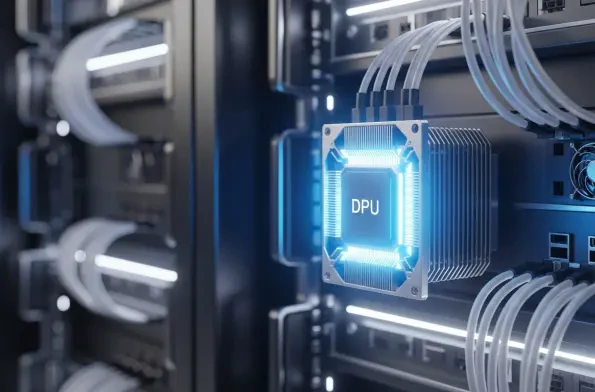
The ESXiArgs campaign was a wake-up call for the industry, affecting an estimated 3,800 servers globally by exploiting the very layer that was supposed to provide isolation. When an attack occurs within the hypervisor, traditional host-based agents are effectively neutralized because the attacker is operating at a level deeper than the security software itself. To mitigate these risks, we have to reimagine the architecture by moving the security stack entirely off the host and into dedicated silicon like Data Processing Units. By using a DPU, the security layer becomes invisible and inaccessible to the attacker, operating independently from the host operating system. This ensures that even if a zero-day vulnerability allows a sandbox escape, the DPU can still enforce policies and monitor traffic at line speed, preventing a single compromise from cascading across dozens of virtual machines.
Most data center traffic moves laterally between virtual machines, yet many defenses still prioritize perimeter monitoring. What are the primary barriers to inspecting internal traffic at line speed, and how does hardware isolation change the way we approach lateral movement detection?
The primary barrier has always been the sheer volume of data; east-west traffic accounts for the vast majority of movement within a data center, and inspecting it with software-based tools would create massive bottlenecks. Legacy firewalls were never designed to handle this internal load, leading to significant dwell time where attackers can escalate privileges and move through the network undetected. Hardware isolation through DPUs changes the game because the security sensor is embedded directly into each server, allowing us to inspect every packet as it leaves the host. This treats the network and the host with zero trust, enabling continuous monitoring of all internal traffic without the need for external appliances. It effectively eliminates the blind spots that attackers rely on to stay hidden for weeks or months after an initial breach.
AI workloads rely on transient containers and network flows that exist for only minutes. How can security teams maintain visibility over these just-in-time assets, and what metrics should be used to ensure monitoring doesn’t throttle the efficiency of expensive GPU clusters?
AI data centers are incredibly dynamic environments where virtual machines and containers materialize and vanish faster than any human operator or manual scan could ever hope to track. These just-in-time assets are often created for a single task and then decommissioned, meaning that by the time a traditional security audit runs, the evidence of a breach might already be gone. We need to shift toward real-time telemetry streaming from the hardware level, which allows us to maintain a living map of these transient flows without interfering with the computational heavy lifting. The most critical metric here is the performance-to-protection ratio, ensuring that we are achieving comprehensive visibility without stealing the cycles that these expensive GPU clusters need to function. It is about moving away from periodic snapshots and toward a continuous, hardware-accelerated stream of intelligence.
Offloading security to Data Processing Units (DPUs) creates a hardware-level zero trust environment. How does this physical separation prevent an attacker from tampering with security policies after a host OS compromise, and how is deep packet inspection handled without exposing sensitive user-layer content?
The beauty of the DPU is that it exists as a separate “island” of security that the host operating system cannot touch or even see, creating a physical boundary that is impossible to cross. Even if an attacker gains full administrative control over the host, they cannot reach into the DPU to disable logging or modify firewall rules, which keeps the security policy tamper-proof. We handle deep packet inspection by extracting information specifically from kernel-level structures and system metadata, rather than peering into the actual application-layer content or user data. This approach allows us to identify malicious patterns and unauthorized access requests with incredible granularity while maintaining strict privacy protections for the data itself. It provides the best of both worlds: total visibility into the behavior of the system without the risk of exposing sensitive user-layer information to the security stack.
What is your forecast for the adoption of DPU-based security architectures?
I believe that within the next few years, DPU-based security will transition from a high-end luxury to a foundational requirement for any modern data center. As AI and high-performance computing continue to push the limits of what standard CPUs can handle, the industry will no longer be able to tolerate the performance drag of legacy, software-only security models. We are moving toward a future where zero trust is not just a policy or a software configuration, but is actually baked into the silicon of every server. This evolution will finally break the “impossible equation,” allowing organizations to achieve peak hardware efficiency while maintaining a level of resilience that can withstand even the most sophisticated hypervisor-level attacks. The age of choosing between speed and safety is coming to an end, and dedicated hardware acceleration is the key that will unlock that future.