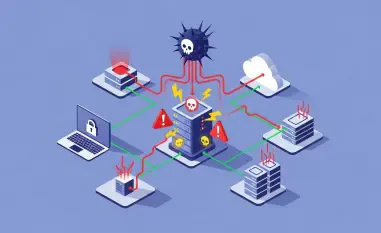
The digital extortion that once locked personal photos for a few hundred dollars has metastasized into a sophisticated criminal enterprise capable of bringing global supply chains to a standstill, demanding multi-million-dollar payments from the world’s largest corporations. This dramatic transformation from a low-level nuisance to a top-tier national security threat underscores the urgent need for a deeper understanding of its evolving tactics. For business leaders, IT professionals, and policymakers navigating an increasingly digitized world, comprehending this shift is no longer optional—it is critical for survival. This analysis will dissect the escalating financial impact of modern ransomware, expose the foundational security failures that enable these devastating attacks, explore the technological accelerants that amplify their reach, and chart a strategic path forward for building true organizational resilience.
The Financial Explosion and Operational Paralysis
From Minor Nuisance to Million-Dollar Demands
The economic scale of ransomware has undergone an exponential and alarming transformation. A decade ago, the cybersecurity landscape was dotted with attacks demanding sums that were, in retrospect, negligible. A 2016 report from Symantec, for instance, placed the average ransom at less than $1,000. Today, that figure seems like a distant memory from a more innocent era of cybercrime. The strategic focus of threat actors has decisively shifted from widespread, low-yield campaigns to highly targeted attacks on high-value corporate and public sector entities.
This calculated pivot has resulted in a staggering inflation of ransom demands. Recent data from 2025 revealed that the average ransom payment had surged to an astonishing $1.3 million, with over half of all recorded payments exceeding that seven-figure threshold. This growth is not merely an increase in price; it reflects a fundamental change in the business model of cybercrime, where attackers now conduct detailed reconnaissance to assess a victim’s ability to pay before launching an attack, ensuring their demands are both crippling and potentially achievable for a desperate organization.
The Crippling Aftermath: Real-World Corporate Disruption
The true cost of a ransomware attack extends far beyond the final sum negotiated with cybercriminals. The operational paralysis that follows a successful breach often inflicts more profound and lasting financial damage than the ransom itself. High-profile incidents in 2025 involving corporate giants like Jaguar Land Rover, Marks & Spencer, and Asahi serve as stark case studies, demonstrating how even a temporary loss of critical systems can halt production lines, disrupt global logistics, and sever customer-facing services for weeks or even months.
Furthermore, organizations that choose not to pay the ransom are not spared from financial catastrophe. The hidden costs associated with a breach are immense and multifaceted. They include staggering expenses for data recovery and system rebuilding, substantial regulatory fines for compliance failures, and the often-unquantifiable but severe long-term reputational damage that erodes customer trust and market value. This grim reality creates a no-win scenario where the aftermath of an attack is a devastating financial event, regardless of whether a ransom is paid.
Expert Consensus: Monetizing Foundational Security Failures
The Core Problem: A Failure of Cyber Hygiene
Despite the advanced delivery mechanisms and sophisticated extortion tactics, a clear consensus has emerged among cybersecurity experts: ransomware is not a problem of advanced hacking so much as a symptom of basic security neglect. Gavin Millard of Tenable offers a blunt but accurate assessment, stating that ransomware is simply “the monetization of poor cyber hygiene.” This perspective shifts the focus from the malware itself to the vulnerabilities that allow it to be deployed in the first place.
This view is strongly reinforced by insights from Etay Maor of Cato Networks, who observes that over 80% of successful attacks are rooted in fundamental security errors. He argues that “the problem isn’t ransomware itself, the problem is everything before that.” Attackers are not typically breaking through impenetrable walls; they are walking through unlocked doors left open by misconfigured systems, delayed patching, or human error. Ransomware is merely the final, and most visible, stage of a much longer chain of preventable security failures.
The Four Pillars of Preventable Breaches
Analysis of thousands of security incidents reveals a consistent pattern of exploitation targeting a handful of recurring weaknesses. These foundational gaps form the pillars of nearly every successful ransomware attack. A primary entry point remains unpatched vulnerabilities, where attackers exploit known software flaws for which security fixes are readily available but have not been applied. This failure to maintain systems provides a reliable and often easy path into a target network.
Equally pervasive is the issue of weak credential security. The continued use of easily compromised passwords, coupled with a lack of robust password management policies, allows attackers to gain initial access through simple guessing or phishing attacks. This problem is severely compounded by the absence of multi-factor authentication (MFA), a critical security layer that can effectively neutralize the threat of stolen credentials. Finally, the principle of excessive user permissions creates a fertile ground for attackers to expand their foothold. When employees are granted unnecessary access rights, a single compromised account can become a gateway for an attacker to move laterally across the network and escalate privileges, turning a minor breach into a full-blown crisis.
Modern Accelerants: Expanding Attack Surfaces and Evolving Tactics
Complexity as a Vulnerability: The Modern IT Environment
The security challenges posed by poor hygiene are being magnified by the sheer complexity of modern enterprise environments. The widespread migration to cloud infrastructure, the deep integration of third-party services, and the proliferation of AI agents have created a vast and fragmented attack surface. This intricate ecosystem is far more difficult for security teams to monitor and control than the centralized, on-premises networks of the past.
This complexity introduces countless new potential entry points for attackers if not managed with extreme diligence. As security experts have noted, the “effort” required to simply identify, prioritize, and remediate critical vulnerabilities within these sprawling digital landscapes is immense. For already-strained security teams, maintaining comprehensive visibility and control has become a monumental task, and any gap in this visibility is an opportunity for a threat actor to exploit.
Exploiting the Human Element: Advanced Social Engineering
As technical defenses have improved, attackers have increasingly focused their efforts on the most unpredictable variable in any security system: the human element. Modern social engineering techniques have evolved beyond generic phishing emails to become highly sophisticated psychological operations designed to manipulate employees into bypassing security protocols.
A potent example of this trend is the “ClickFix” method. In this scenario, attackers present a user with a fake but convincing error message or verification prompt. This pop-up then instructs the user to copy and run a snippet of code in their terminal or command prompt to “fix” the issue. In reality, the user is tricked into executing a malicious script that compromises their own system. This technique is dangerously effective because it co-opts the victim into becoming an active participant in the attack, using their legitimate access to circumvent the organization’s defenses from the inside.
AI as a Force Multiplier for Cybercrime
The advent of generative AI has dramatically lowered the barrier to entry for cybercrime and supercharged the capabilities of established threat groups. AI tools now enable even low-skilled attackers to create highly customized and grammatically perfect phishing emails, tailored to specific individuals, industries, or regions, which significantly increases their success rate. AI can also be used to generate novel strains of malicious code on demand, accelerating the development of new attack tools.
An even more ominous development is the use of AI-powered deepfake audio and video. Attackers are beginning to leverage this technology to impersonate senior executives or IT support staff in real-time conversations. A phone call featuring the “CEO’s” voice urgently requesting network credentials or a video conference with a “help desk technician” guiding an employee through a series of compromising actions can create scenarios that are incredibly persuasive and difficult for even a well-trained employee to detect as fraudulent.
Breaking the Vicious Cycle: The Path to Resilience
The ransomware economy is driven by a simple and powerful engine: profitability. As long as organizations continue to pay ransoms, the business model will thrive, providing cybercriminals with the capital to fund research and development into more advanced and scalable attacks. Gavin Millard argues that paying a ransom is a tacit admission of a failed disaster recovery plan and ultimately serves only to “enable attackers to invest more money into making ransomware faster and more scalable,” thus perpetuating a vicious cycle.
Disrupting this cycle requires a fundamental shift in corporate mindset. As Etay Maor suggests, “The problem is not the problem, the problem is your attitude about the problem.” The solution does not lie in finding a silver bullet to stop ransomware payloads, but in building a robust, preventative security posture designed to break the attack chain at its earliest stages. This means moving beyond a reactive stance and committing to the disciplined, consistent application of foundational security principles. This includes an unwavering commitment to timely security patching, the strict enforcement of multi-factor authentication across all systems, the rigorous implementation of the principle of least privilege, and ensuring security teams have the resources and authority to execute their mission effectively.
Conclusion: From Reactive Defense to Proactive Resilience
The trend analysis confirmed that ransomware had evolved from a simple form of digital extortion into a highly profitable criminal enterprise. This evolution was fueled by a persistent failure to address foundational security weaknesses within organizations and was amplified by the growing complexity of modern technology and the weaponization of artificial intelligence. The most effective strategies identified were not those focused on the final ransomware payload, but those designed to disrupt the attack chain long before a catastrophic encryption event could occur. Ultimately, the path forward required a decisive organizational shift from a reactive to a proactive security posture, driven by the understanding that a sustained investment in fundamental cyber hygiene was profoundly less costly than the catastrophic consequences of a successful attack.