The digital corridors of modern medical facilities are currently under siege from a relentless tide of technical weaknesses that many institutions are simply not equipped to manage with the necessary speed or precision today. This phenomenon, known as a vulnerability flood, describes an overwhelming surge in discovered flaws within network infrastructures that provide critical patient care services. The primary driver of this crisis is the rapid evolution of artificial intelligence, which has lowered the barrier for malicious actors to conduct high-frequency attacks. Specialized AI agents are now capable of automating the process of finding security gaps and drafting custom exploits in a matter of hours, a task that previously required weeks of manual research. As these automated tools become more accessible, healthcare providers find themselves in a race against a clock that moves much faster than their internal administrative cycles. This shift represents a change in the threat landscape, as the volume of threats can paralyze traditional security operations.
Technical Debt: The Risks of Legacy Hardware Durability
A major contributor to this risk is the heavy reliance on legacy technology within clinical settings, where friction between mechanical longevity and software obsolescence creates significant risk. MRI scanners, CT machines, and complex laboratory analyzers are often designed to function for fifteen to twenty years, yet their underlying operating systems may stop receiving security updates after only five. This creates a persistent risk where high-value clinical assets act as stagnant backdoors into the modern hospital environment. Because these devices are expensive and integral to daily operations, they are rarely taken offline for extensive security hardening or replacement until they physically fail. Attackers understand this dynamic and specifically target these unpatchable systems as entry points for larger campaigns. The resulting imbalance between physical durability and digital fragility leaves the healthcare sector particularly exposed to exploits that have long since been neutralized in more agile industries.
Rapid Exploitation: The Impact of Agentic Vulnerability Scanning
Parallel to the hardware challenge is the rise of agentic vulnerability scanning, where sophisticated large language models are employed to analyze vast amounts of source code at an unprecedented scale. These AI-driven platforms can dissect a newly released security patch from a software vendor and reverse-engineer a functional exploit before a hospital’s IT department has even begun to assess the update’s compatibility with their systems. This capability effectively erases the traditional grace period that security teams once relied upon to test and deploy fixes. In this environment, the time between the public announcement of a flaw and its active exploitation has shrunk from days to minutes. Organizations are no longer fighting against individual hackers, but against automated logic engines that do not sleep. This technological acceleration demands a move away from manual patching schedules toward more dynamic, automated defense mechanisms that can match the speed of the current AI-driven threats.
Institutional Barriers: Bridging the Divide Between IT and Operational Technology
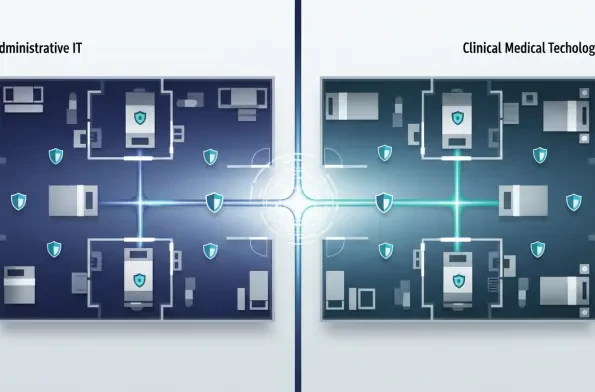
Organizational fragmentation remains a significant barrier to securing medical networks against AI-enhanced threats, particularly the traditional divide between Information Technology and Operational Technology. While IT departments are usually focused on the security of databases and administrative workstations, Operational Technology teams are responsible for the specialized medical devices that interact with patients. These two groups often operate in silos, utilizing different monitoring tools and distinct protocols that rarely overlap. This lack of coordination creates blind spots across the network, allowing sophisticated attackers to move between administrative and clinical environments without triggering a unified alarm. When an intrusion occurs, the time wasted navigating internal bureaucracy or determining which team owns a compromised asset can be catastrophic. Bridging this gap requires a unified security architecture that provides visibility across both domains and ensures that all devices are under constant surveillance.
Shrinking Response Windows: Managing the Reduction in Attacker Dwell Time
The consequences of these internal divisions are most apparent when examining the shrinking window of dwell time, which refers to the period an unauthorized user remains undetected within a network. Recent data suggests that the median dwell time has plummeted to roughly seventy-two hours, leaving very little room for a successful defensive intervention before data is exfiltrated or systems are encrypted. In a hospital, a delay in response can mean the difference between a minor service interruption and a total shutdown of emergency services. Jurisdictional confusion between IT and OT staff regarding who is authorized to take a specific device offline often leads to critical hesitation during the early stages of a breach. Attackers leverage this window to escalate their privileges and establish permanent persistence within the system. To counter this, facilities must establish clear, pre-authorized response playbooks that eliminate the need for lengthy consultations during an active security event.
Defensive Architecture: Implementing Zero-Trust and Network Micro-Segmentation
Developing a resilient defense in this high-speed environment requires a departure from traditional perimeter-based security models in favor of a Zero-Trust framework and micro-segmentation. By treating every device and user as potentially compromised, hospitals can implement granular controls that isolate clinical equipment from the broader administrative network. This strategy ensures that even if a single terminal or medical device is breached, the attacker is confined to a small segment of the network and cannot access sensitive electronic health records or other critical systems. Furthermore, integrating AI into defensive traffic monitoring allows administrators to establish a baseline of healthy network behavior. These systems can then flag abnormal data patterns or unusual communication between devices in real-time, providing an early warning system that human analysts might miss. This proactive stance is essential for identifying the footprints left by automated attack tools before they cause damage.
Future Proofing: Strategic Integration of Automated Security Protocols
The shift toward a more proactive posture involved a comprehensive reassessment of how medical facilities prioritized their digital investments and managed their long-term infrastructure. Leading institutions recognized that they could no longer treat cybersecurity as a secondary IT expense but instead viewed it as a fundamental component of patient safety. They successfully integrated cross-functional response teams that unified the expertise of clinical engineers and cybersecurity analysts, ensuring that no device remained unmonitored. These organizations also began demanding higher security standards from their medical device vendors, insisting on longer support cycles and easier patching processes. By adopting automated threat intelligence feeds and implementing self-healing network protocols, they managed to stay ahead of the vulnerability flood. The focus moved from merely preventing intrusions to ensuring that the network could maintain core functions even while under active attack. These strategic changes provided a clear roadmap.