We’re joined today by Malik Haidar, a cybersecurity expert who has spent years on the front lines protecting multinational corporations from complex threats. With a deep background in analytics and intelligence, Malik brings a unique business-focused perspective to the rapidly evolving world of physical security. We’ll be exploring the significant shift enterprises are making toward biometric access control, moving beyond traditional key cards to more sophisticated, secure, and user-friendly solutions. Our discussion will cover the driving forces behind the explosive growth in facial recognition technology, how modern systems address critical privacy concerns, and what organizations should look for when implementing these future-ready systems. We’ll also touch on its integration into multi-factor authentication strategies and its impact on the broader employee experience.
Companies are moving from traditional key cards and fingerprint scanners due to security and hygiene issues. What specific vulnerabilities does facial recognition address, and how does it create a more robust yet frictionless experience for employees in high-traffic areas? Please provide a practical example.
The vulnerabilities of older systems are something I’ve seen exploited time and again. A key card is just a token; it doesn’t verify the person holding it. It can be lost, stolen, or “borrowed” by a disgruntled former employee. PIN codes can be phished or simply shoulder-surfed. And while fingerprint scanners were a step up, the “touch” element became a major concern, creating friction and hygiene issues, especially post-pandemic. Facial recognition directly ties access to the individual’s unique identity in a completely contactless way. Imagine the main lobby of a corporate headquarters at 9 a.m. Instead of a clumsy queue of people fumbling for badges or pressing their fingers on a scanner, you have a steady, seamless flow. Employees just walk through at a normal pace, the system authenticates them in a fraction of a second, and the gates open. It eliminates the risk of shared credentials and the operational bottleneck, creating an experience that feels both incredibly secure and effortlessly modern.
The market for biometric physical access control is seeing explosive growth, projected to increase by 200% over the next decade. What key factors are driving this rapid adoption across diverse industries like healthcare and finance, and what specific security challenges are they hoping to solve with this technology?
That 200% growth projection, topping $7.8 billion, is fueled by a perfect storm of factors. First, the threat landscape has become far more sophisticated. Organizations in sectors like finance and healthcare aren’t just protecting office equipment; they’re safeguarding sensitive data, critical infrastructure, and intellectual property. Regulatory pressures are also a huge driver; compliance standards demand auditable, person-specific proof of who accessed a location and when. Biometrics provide that undeniable link. On the technology side, advances in imaging, sensors, and algorithms have made systems like facial recognition incredibly accurate and affordable. A hospital, for example, needs to control access to pharmaceutical storage or patient record rooms without burdening doctors and nurses who might be wearing gloves or have their hands full. A frictionless, contactless system solves that perfectly. It’s about achieving a higher level of precision in identity management to answer the fundamental questions: who, when, and where.
While user surveys show privacy concerns about biometrics, adoption continues to rise. How do modern facial recognition systems address these privacy issues, specifically regarding data storage? Please explain the difference between storing biometric data in a central database versus on a credential itself.
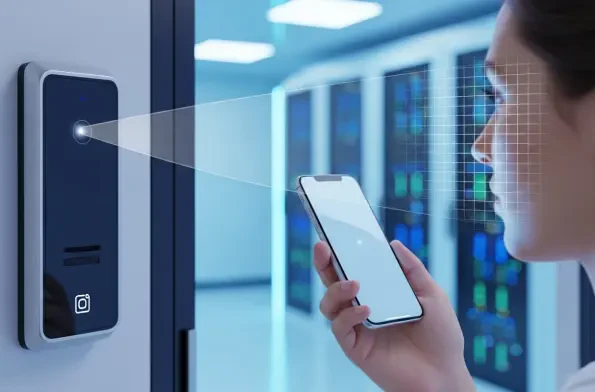
This is the most critical conversation to have during implementation, as trust is paramount. The old model involved creating a central database of thousands of facial templates, which, if breached, would be a catastrophic privacy event. The industry has made a significant pivot to address this. The most secure and privacy-respecting approach is to store the biometric data on a credential that the employee controls, like their mobile phone or a smart card. When the employee approaches a reader, their face is scanned and converted into a template. This new template is then compared locally against the one securely stored on their personal credential. The system is just doing a 1:1 match to verify the person holding the card is the authorized user. The template never has to be transmitted to or stored on a centralized server, which dramatically reduces the risk and gives individuals control over their own biometric data.
Multi-factor authentication is a strategic priority for many firms. How does facial recognition integrate into an MFA strategy for physical access? Could you walk us through a scenario where an employee uses their face plus another credential, like a mobile phone, to enter a highly sensitive area?
Facial recognition is a natural and powerful component for physical MFA, which is why nearly three-quarters of organizations are incorporating biometrics into their strategies. It elevates security from “something you have” to a combination of “something you have” and “something you are.” Let’s imagine an engineer needing access to a data center. For general building entry, her face alone is enough for fast, convenient access. But to enter the server room, the security policy requires a second factor. As she approaches the data center door, she first presents her mobile credential to the reader. The reader then activates its camera. The system authenticates her face in about 0.2 seconds and confirms that the person presenting the mobile credential is the true, live owner. Only after both factors—the phone and the face—are verified does the door unlock. This layered approach provides incredibly strong security for critical assets without adding significant friction for the authorized user.
When evaluating a facial recognition system, what are the most critical technical features an organization should prioritize? Beyond a high accuracy rating, could you detail the importance of camera quality for low-light conditions, recognition speed, and seamless integration with existing security hardware?
Accuracy is the headline, and you should absolutely look for systems that perform well on standardized tests like the NIST FRTE, aiming for that 99.97% benchmark. But real-world performance depends on the hardware. High-quality readers are non-negotiable. I always recommend systems with dual 1080p cameras—one for visible light and a second for near-infrared. The IR camera is the hero in challenging conditions, allowing the system to work in dimly lit corridors or even complete darkness, which is vital for 24/7 operations. Recognition speed is just as crucial for user experience; anything slower than 0.2 seconds will cause delays and frustration in high-traffic areas. Finally, the system must be a team player. It needs to integrate smoothly with your existing access control panels and software using standard protocols like OSDP or Wiegand. A technically brilliant but isolated system creates more problems than it solves.
Implementing a new access control system involves more than just IT and security; it impacts departments like HR and operations. What are the key considerations for these other stakeholders, and how can a well-chosen facial recognition system improve their daily workflows and the overall employee experience?
This is an often-overlooked aspect. A security project can feel like a top-down mandate, but a well-implemented facial recognition system offers tangible benefits across the board. For HR, think about the onboarding process. Instead of managing the logistics of printing and distributing physical cards, a new employee’s access can be enabled seamlessly as part of their digital onboarding. It also modernizes the perception of the workplace from day one. For operations and facilities management, the high throughput of walk-through authentication prevents bottlenecks in lobbies and elevators, leading to a more efficient and pleasant building environment. When you remove the daily friction of finding a badge or worrying about a forgotten PIN, you improve the overall employee experience. It sends a message that the company values both their security and their time.
What is your forecast for facial recognition in access control?
My forecast is that it will cease to be seen as an “emerging” technology and will simply become the standard for modern physical access control. The technology directly solves the core challenges enterprises face today: the need for stronger identity assurance, the demand for frictionless user experiences, and the operational requirements of high-traffic environments. As organizations continue to invest in long-term, scalable security strategies, facial recognition offers the best balance of robust security, operational efficiency, and usability. It is the only modality that can provide true walk-through authentication, and its ability to integrate cleanly into multi-factor environments makes it a cornerstone technology. It’s no longer a question of if organizations will adopt it, but how they will standardize on it to protect their people and assets without compromise.