The recent debut of the VolkLocker ransomware platform serves as a stark reminder that in the world of cybercrime, a threat’s potential for destruction is not always matched by the sophistication of its design. The Ransomware-as-a-Service (RaaS) model continues to lower the barrier to entry for malicious actors, and this review explores VolkLocker, a new offering from the hacktivist group CyberVolk. This analysis will dissect its key features, a critical implementation flaw that undermines its core purpose, and the impact it has on the broader threat environment.
This review provides a thorough understanding of this emerging ransomware, detailing its current capabilities and operational model. By examining both its strengths and its fatal weaknesses, a clearer picture emerges of the evolving landscape where even flawed tools can present a tangible risk to unprepared targets. It is a case study in the democratization of cybercrime and the challenges defenders face.
An Introduction to the VolkLocker Threat
VolkLocker is a new ransomware strain written in the versatile Go programming language, specifically designed for cross-platform attacks targeting both Windows and Linux systems. It is operated by CyberVolk, also known as GLORIAMIST, a pro-Russian hacktivist group that has pivoted toward financially motivated cybercrime. Its emergence highlights a growing trend of politically motivated threat actors expanding their operations to include for-profit ventures.
The ransomware is sold as a complete RaaS package, leveraging accessible platforms like Telegram to build and distribute its malicious tools. This method of operation provides a convenient and resilient infrastructure for the criminal enterprise, allowing the group to reach a wide base of potential affiliates with varying levels of technical expertise.
Technical Analysis and Core Functionality
Encryption and Destructive Routines
Once executed on a victim’s machine, VolkLocker exhibits the behaviors of a typical modern ransomware strain. The malware immediately attempts to escalate its system privileges to gain deeper control. Following this, it scans the system for a wide range of file types to encrypt using the strong AES-256 GCM algorithm, ensuring that data is rendered inaccessible without the correct key.
To further complicate recovery efforts, the ransomware takes aggressive steps to hinder system restoration and analysis. These actions include deleting volume shadow copies to prevent easy file recovery, modifying the Windows Registry to establish persistence across reboots, and actively terminating processes associated with security tools like Microsoft Defender Antivirus.
The Critical Implementation Flaw
The most significant finding in VolkLocker’s design is a fatal vulnerability that completely undermines its extortion capabilities. Security researchers discovered that the ransomware uses a single, hard-coded master key to encrypt all files on a victim’s machine, a glaring error in cryptographic implementation.
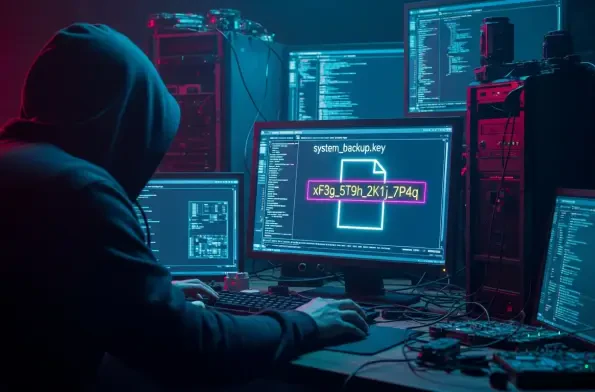
Compounding this fundamental mistake, the malware writes this master key to a plaintext file named system_backup.key and saves it in the temporary user folder. Because this key is not deleted after the encryption routine finishes, it provides a simple and effective method for victims to decrypt their files for free, rendering the entire ransomware operation ineffective if discovered.
Ransom Enforcement and Pressure Tactics
Despite its decryption flaw, VolkLocker includes an aggressive enforcement mechanism designed to pressure victims into quick payment. The ransomware initiates a 48-hour timer, threatening dire consequences if the deadline is missed. Furthermore, if an incorrect decryption key is entered three times, the malware proceeds to its final, destructive stage.
This destructive element is programmed to permanently wipe the contents of the user’s most valuable folders, including Documents, Desktop, Downloads, and Pictures. This feature adds a significant risk of permanent data loss, particularly for victims who are unaware of the underlying cryptographic flaw and may panic under the pressure of the countdown.
The RaaS Business Model and Distribution
CyberVolk operates its RaaS business entirely through Telegram, a platform that provides an ideal environment for its criminal enterprise due to its anonymity and resilience. The group sells VolkLocker payloads for prices ranging from $800 to $1,100 for a single operating system version. For affiliates seeking broader impact, a package covering both Windows and Linux is available for up to $2,200.
The malware payloads are designed for ease of use, featuring built-in Telegram automation for command-and-control that allows affiliates to manage their attacks with minimal technical overhead. Seeking to diversify its revenue, CyberVolk has also expanded its offerings to include a remote access trojan and a keylogger, signaling its ambition to become a one-stop shop for aspiring cybercriminals.
Real World Impact and Target Profile
VolkLocker’s design to target both Windows and Linux systems indicates its intended use against a wide range of victims. This cross-platform capability makes it a potential threat to everyone from individual users to sprawling corporate networks that rely on a mix of operating systems for their servers and workstations.
Its distribution as a RaaS package via Telegram makes it accessible to a broad spectrum of affiliates, including those with limited technical skills who would otherwise be unable to conduct such attacks. The built-in C2 functionality simplifies deployment significantly, allowing attackers to focus their efforts on gaining initial access to victim networks rather than on managing complex malware infrastructure.
Attacker Challenges and Operational Vulnerabilities
The primary challenge facing the VolkLocker RaaS is its own critical design flaw. The existence of a hard-coded, exposed master key renders the ransomware ineffective as soon as a victim or security researcher discovers it. This vulnerability severely damages the credibility of the service and its viability in the competitive cybercrime market.
For VolkLocker to become a credible and profitable threat, CyberVolk would need to completely re-engineer its cryptographic implementation and key management process. This represents a significant technical hurdle for a group that has already demonstrated poor operational security, making a successful relaunch a difficult proposition.
Future Outlook for VolkLocker and Similar Threats
The future of VolkLocker is uncertain. In light of its publicized flaws, CyberVolk will likely be forced to either abandon the project or attempt to release a patched version that corrects the key management vulnerability. A “VolkLocker 2.0” could emerge, but the damage to the brand’s reputation may be irreparable.
Regardless of its fate, VolkLocker serves as an important case study for the evolving threat landscape. It demonstrates the clear trend of hacktivist groups monetizing their skills through traditional cybercrime. Moreover, it highlights how easily accessible platforms like Telegram are being co-opted to build and operate RaaS platforms, suggesting that more such threats will inevitably emerge.
Conclusion A Flawed but Significant Development
VolkLocker is a functionally destructive but cryptographically broken piece of ransomware. While the critical vulnerability allows for free data recovery, its existence is a telling indicator of the current cybercrime ecosystem, where the RaaS model is enabling a new wave of threat actors to enter the ransomware scene with powerful, albeit sometimes flawed, tools.
The analysis of VolkLocker ultimately revealed a threat that was more instructive than effective. Its case proved that even amateurishly designed malware could pose a tangible risk through its destructive secondary features. This incident underscored the absolute necessity of thorough and continuous security analysis in developing proactive countermeasures against the constant stream of emerging digital threats.