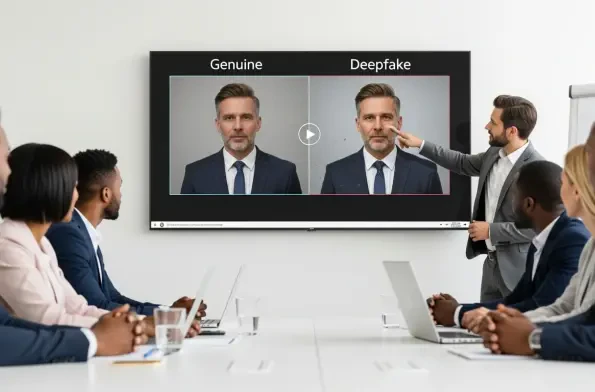
Deepfake Fraud: Why Detection Is a Losing Battle
What was once considered a niche technological curiosity has become a sophisticated instrument of corporate deception. AI-generated synthetic media, or deepfakes, are challenging traditional trust assumptions, shifting from a theoretical threat to a social engineering tool that empowers cybercriminals worldwide to circumvent established verification practices.
In 2024, a finance employee at a multinational firm in Hong Kong was tricked into paying $25 million to fraudsters who used deepfake technology to pose as the company’s chief financial officer during a video conference call.
And as these technologies become more accessible and convincing, enterprises face an urgent mandate: understand the mechanics of this threat and create formidable defenses against cyberattacks that exploit human trust to avoid financial loss, damage to reputational integrity, and internal instability.
The Anatomy of a Trust Crisis
The escalation of deepfake-related fraud was not a gradual trend but a significant surge, growing alongside advances in artificial intelligence. According to Onfido’s 2024 Identity Fraud Report, there was a 3,000% increase in deepfakes in just one year. And the financial sector is the primary battlefield targeted by malicious actors. The cryptocurrency industry accounts for a large amount of detected deepfake incidents, with an alarming scale of damage (on average, enterprises across industries lose nearly 0,000 to these attacks). Moreover, research reveals that GenAi could enable fraud losses to reach billion in the United States by 2027, with a compound annual growth rate of 32%.
A dangerous preparedness gap amplifies this financial hemorrhaging, as many institutions acknowledge the risk of deepfakes to their business but have no clear mitigation plan and little familiarity with the technology.
Detection Alone Is Insufficient
Corporate inertia is particularly troubling because both human and technological detection methods are failing. When researchers tested systems against actual deepfakes circulating online, accuracy fell significantly. State-of-the-art detection systems saw performance drop by 45-50%, with some achieving only around 65% accuracy in real-world scenarios. Human experts struggle too, with people detecting deepfakes correctly only 55-60% of the time. This combined limitation forces cybersecurity professionals to move away from single-point verification and reconsider reliance on traditional identity tools as standalone safeguards.
This reality demands a shift toward multi-layered security frameworks that incorporate behavioral analytics and stringent human confirmation protocols. Beyond direct corporate attacks, the societal impact is profound. Deepfake-powered scams pose a massive threat by accelerating disinformation, blurring the line between AI- and human-generated content, fueling public anxiety and eroding trust in digital media.
Fortifying Defenses in a Post-Authenticity World
To avoid becoming the victim of advanced social engineering efforts, organizations must now operate under the assumption that any digital communication could be compromised. It’s a mindset that requires a fundamental reinforcement of verification processes across all critical operations. Establishing clear, multi-step confirmation procedures for financial transactions, executive authorizations, and sensitive data requests is no longer optional; it is now a mandatory investment to mitigate material financial and reputational exposure.
A simple verbal confirmation over a trusted secondary communication channel can thwart a multi-million-dollar fraud attempt. It’s a human-centric approach that must be supported by continuous employee education, with training that moves beyond theoretical warnings to include credible, industry-specific examples of audio and visual manipulation.
Transforming the workforce into an active, constant line of defense means empowering employees to recognize contextual red flags—such as unusual urgency, deviations from standard process, or unexpected changes in communication patterns—rather than relying on visual or audio imperfections that may no longer be detectable. Building this awareness allows for a critical safeguard, turning potential victims into vigilant protectors.
Here is a realistic scenario. A controller receives an urgent email and a follow-up audio message, seemingly from the Chief Financial Officer, demanding an immediate wire transfer to a new vendor for deal closure. The voice sounds authentic. However, the company has previously considered the potential threats posed by such an attack, having implemented a new protocol that requires secondary confirmation for any unscheduled payment over $10,000. To verify the authenticity of this situation, the controller calls their Chief Financial Officer on the known mobile number, who then confirms no such request was ever made. Such a simple, process-driven intervention just prevented a six-figure loss, a situation that would previously have relied solely on an employee’s suspicion.
Adopting a Zero-Trust Communication Framework
The selection and deployment of internal artificial intelligence systems also play a crucial role in mitigating risk. Enterprises should prioritize adopting platforms built with robust data governance, clear access controls, and strong contractual and technical safeguards to reduce external exposure. Well-managed, secure intelligent ecosystems can reduce opportunities for misuse and limit unnecessary exposure of sensitive voice or likeness data, cutting off the raw materials bad actors use to create forgeries.
Implementing ethical AI technologies that safeguard proprietary data positions companies to defend against external threats. It’s an action that preserves brand trust and maintains compliance with evolving privacy and security standards, thereby shaping a strategic alignment of technology and policy and creating a resilient protection posture. Choosing this approach ensures an organization’s own innovative tools do not become vectors for its exploitation, adapting and fortifying corporate culture with the skepticism needed for next-gen safeguards in today’s digital world.
The New Mandate for Verification
Digital trust is undergoing structural strain. Deepfake technology has decisively shifted from theoretical risk to an effective tool for sophisticated cybercrime, with catastrophic financial and reputational consequences. The data reveals a critical preparedness gap, with leadership teams racing to implement adequate training or defensive measures before it is too late.
During these new circumstances, delayed action increases financial and operational risk. Relying on employee intuition or traditional detection software is an outdated strategy. Leaders are learning to navigate a new era in which digital authenticity can no longer be taken for granted. The focus must shift from detecting fakes to building processes that continue to function even when communications are compromised.
A multi-faceted approach centered on process and culture, not just technology, must emerge. The key priorities should include:
- Implementing Multi-Channel Verification: Mandate out-of-band confirmation using a pre-established, trusted channel for all high-stakes requests, including financial transfers and data access.
- Conducting Continuous, Up-to-Date, and Practical Training: Move beyond annual security briefings to regular simulations that expose employees to the latest deepfake audio and video tactics.
- Develop a Rapid Response Protocol: Outline a clear action plan for when a deepfake attempt is identified to mitigate damage and quickly inform stakeholders of risk.
- Secure Biometric Data: Treat voice and video data of executives and key personnel as vitally sensitive assets, restricting access and preventing their use in public-facing systems.
Conclusion
Ultimately, building resilience against deepfake threats is not a one-time project but a continuous cultural adaptation. It requires fostering a healthy skepticism and embedding verification into the core of every business process. The organizations that thrive will be those that stop trying to win a purely reactive detection race and instead re-architect their operations for a world where seeing is no longer believing.