The secure fortress you believe your computer to be might have its most crucial guard asleep at the gate during the most vulnerable moments of its startup sequence. A recently disclosed vulnerability reveals that the very firmware designed to establish a foundation of trust is failing at its job, leaving a gaping hole in the defenses of systems from several leading motherboard manufacturers. This issue exposes a dangerous disconnect between a system’s advertised security and its actual state, creating an opportunity for attackers to strike before the operating system is even aware.
This article serves as a comprehensive FAQ to navigate the complexities of this critical security flaw. Its objective is to explain the nature of the vulnerability, often called the “Sleeping Bouncer” problem, and clarify its potential impact on users. Readers can expect to learn precisely how this flaw works, which systems are affected, and what steps are necessary to ensure their hardware’s integrity is restored.
Key Questions or Key Topics Section
What Is the Sleeping Bouncer Vulnerability
At the heart of modern system security lies a partnership between the Unified Extensible Firmware Interface (UEFI) and the Input-Output Memory Management Unit (IOMMU). The UEFI is the software that initializes the hardware when a computer starts, while the IOMMU is a hardware component that acts as a gatekeeper, preventing peripheral devices from accessing system memory without authorization. This protective measure, known as Pre-Boot Direct Memory Access (DMA) Protection, is essential for stopping malicious hardware from compromising the system during startup.
The “Sleeping Bouncer” vulnerability stems from a fundamental failure in this process. Affected UEFI firmware incorrectly reports to the operating system that DMA protection is active from the very beginning of the boot sequence. However, in reality, the firmware fails to properly configure and enable the IOMMU during these critical initial moments. This creates a brief but potent window of opportunity where the system is completely exposed, akin to a bouncer standing guard but being fast asleep, allowing threats to slip past unnoticed.
How Can This Flaw Be Exploited
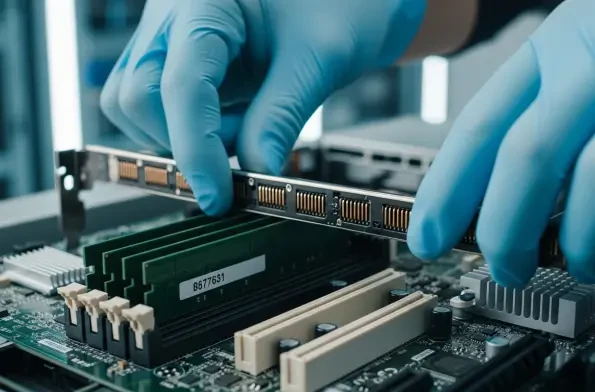
Exploiting this flaw requires physical access to the target machine. A sophisticated attacker can connect a malicious, DMA-capable Peripheral Component Interconnect Express (PCIe) device to an exposed port on the motherboard. During the unprotected early-boot phase, before the operating system and its security features have loaded, this rogue device can initiate DMA transactions. These transactions allow the device to directly read sensitive data from system memory or, more dangerously, write malicious code into it.
The consequences of a successful attack are severe. An attacker could extract credentials, passwords, or encryption keys stored in memory. Alternatively, they could inject code that executes with the highest system privileges, fundamentally altering the initial state of the machine. This injected malware could then conceal its presence from the operating system, establishing a persistent and low-level foothold. This type of compromise undermines the entire chain of trust, as the system’s integrity is violated before its defenses are even awake.
Which Systems and Motherboards Are Affected
The vulnerability is widespread, impacting a significant number of motherboards from major industry vendors. The issue has been assigned a high-severity CVSS score of 7.0 and is tracked across several distinct identifiers. For instance, CVE-2025-14304 affects motherboards from ASRock, ASRock Rack, and ASRock Industrial using Intel 500 through 800 series chipsets. Similarly, CVE-2025-11901 pertains to a wide range of ASUS motherboards with Intel chipsets, including the Z490, Z590, Z690, and Z790 series, among others.
GIGABYTE motherboards with both Intel and AMD chipsets are also impacted under CVE-2025-14302, covering Intel series from 600 to 800 and AMD series like X670, B650, and TRX50. It is important to note that the firmware fix for the GIGABYTE TRX50 chipset is planned for the first quarter of 2026. Furthermore, CVE-2025-14303 addresses the flaw in MSI motherboards utilizing Intel 600 and 700 series chipsets, demonstrating the extensive reach of this firmware implementation error.
Why Does This Vulnerability Matter Beyond Gaming
While the flaw was discovered by security researchers at Riot Games in the context of preventing hardware-based cheating, its implications extend far beyond the gaming world. The IOMMU is a foundational technology for security in virtualized and cloud computing environments. In data centers, it is essential for enforcing strict security boundaries between different virtual machines and between those machines and the host hypervisor. A failure to correctly initialize this unit could have cascading security consequences.
This vulnerability highlights the critical need for diligent firmware configuration and verification on all systems, from personal desktops to enterprise servers. An attacker could leverage this flaw for corporate espionage, data theft, or system sabotage in any setting where physical access might be possible. Consequently, the flaw underscores a systemic risk in how foundational security features are implemented and trusted, affecting the core principles of isolation and trust delegation in modern computing infrastructure.
Summary or Recap
The core of the issue is a critical discrepancy between the security features a motherboard claims to have enabled and what is actually functioning during the initial boot process. This “Sleeping Bouncer” problem leaves a window open for highly invasive DMA attacks, allowing physically present attackers to compromise a system’s integrity before any software-based defenses are active. The only effective mitigation is the application of firmware updates, which correct the IOMMU initialization sequence and ensure DMA protection is enforced from the very start.
This situation reinforces the essential takeaway that system security is a layered process, and its foundation rests upon the proper functioning of hardware and its firmware. The broad impact across multiple leading vendors shows that trust in these components cannot be assumed but must be actively managed. Prompt patching is therefore crucial for any individual or organization using affected hardware, especially in environments where physical access to systems cannot be fully guaranteed.
Conclusion or Final Thoughts
This widespread UEFI vulnerability served as a powerful reminder that security is only as strong as its weakest link, and in this case, the weak link was found in the very foundation of the system boot process. The trust that users and organizations place in hardware vendors to correctly implement fundamental security controls was shown to be fallible. The incident demonstrated that even when a security feature is present and appears to be enabled, its actual implementation may be flawed, leaving systems unexpectedly exposed.
Ultimately, the discovery prompted a necessary re-evaluation of firmware security practices across the industry. It encouraged a shift from a posture of passive trust toward one of active verification and diligence. For end-users and administrators, this event highlighted the critical importance of not only enabling security features but also staying informed about potential implementation flaws and applying firmware updates as soon as they become available. The integrity of a system begins long before the login screen appears.