How legitimate calendar subscriptions enable scalable phishing and malware delivery
Millions rely on calendar subscriptions for frictionless updates to holidays, school events, sports fixtures, and store promotions, yet the same convenience masks a quiet channel that continuously syncs in the background long after users forget they opted in and persists until someone upstream changes the feed or its domain control. This research asked a direct question: how are third-party calendar subscriptions being abused to deliver malicious content at scale without tripping common protections or demanding new consent?
The central challenge stems from silent persistence and a lack of visibility. Background syncs continue even when domains expire, get hijacked, or shift owners, making calendar feeds function like a supply chain once upstream control moves to adversaries. The scope is systemic rather than vendor-specific; the exposure follows common .ics and webcal behaviors across ecosystems, where no single platform bug explains the risk.
Background and significance: From email defenses to overlooked calendar attack surfaces
Calendar subscriptions are attractive because they feel trustworthy and helpful; they auto-update, keep schedules current, and rarely interrupt. However, unlike email, they seldom pass through layered filtering, reputation checks, or strong prompts. As a result, calendar content inherits trust while bypassing the mature controls that govern inboxes.
This shift matters now because attackers favor low-friction, high-trust rails over noisy exploitation of core platforms. The consequences span consumers who click familiar-looking events, enterprises whose devices quietly accept feed updates, and AI assistants that act on calendar entries, links, and attachments as if they were benign tasks.
Research Methodology, Findings, and Implications
Methodology
The study began with a sinkholed domain that had previously hosted German public and school holiday calendars, collecting passive telemetry from incoming sync requests. Request semantics were examined to distinguish long-lived background syncs from fresh subscription attempts, clarifying whether contact reflected persistence or new opt-ins.
Mapping expanded through DNS records, certificate history, and keyword clustering to surface additional calendar-related domains, including sports and religious calendars. Unique IP counts, geographic spread, and daily contact volumes were aggregated, and the ability to serve customized .ics payloads was validated to show that events could be added or modified across subscribed devices.
Findings
Roughly 11,000 unique IPs contacted the initial sinkholed domain each day, signaling an entrenched base of active subscriptions. The broader sweep uncovered 347 more calendar-related domains that collectively drew about four million unique IPs daily, with the highest concentration in the United States.
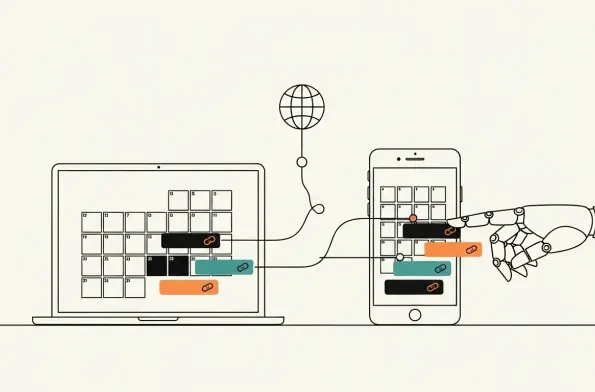
Two distinct sync request types confirmed that traffic reflected ongoing background syncing rather than new opt-ins. Expired or hijacked domains tied to popular calendars offered immediate, durable reach, enabling attacker-controlled servers to push weaponized .ics content—malicious links, attachment URLs, script references, and persuasive lures—without user awareness.
Implications
In practical terms, calendar feeds operate as a push channel analogous to a supply chain: upstream control yields downstream mass distribution. Security programs rarely inventory subscriptions, monitor webcal traffic, or apply content controls, leaving a blind spot that blends trust with automation.
This is not a flaw in a single platform; the risk is baked into third-party subscription mechanics and domain lifecycle churn. Emerging vectors include drive-by phishing via linked pages, potential JavaScript exposure after clicks, and AI assistants that may execute actions based on tainted events.
Reflection and future directions
Reflection
A key challenge was separating genuine user subscriptions from automated or intermediary traffic, while NAT and CDN behaviors complicated efforts to equate IPs with users. To reduce noise, the study relied on request semantics and timing to infer background sync patterns and cross-referenced DNS and certificate telemetry.
Limits remained: closed ecosystems and device-level rendering behaviors restricted visibility, and user interaction data was not available. Future analyses could probe vendor-specific sync intervals, parser quirks, and attachment handling to understand how platforms shape both risk and mitigation.
Future directions
Broader sinkhole measurements across retail promotions, sports leagues, and school districts would clarify scale and seasonality. Standards work could explore feed signatures, provenance metadata, domain-change prompts, and optional revocation mechanisms to restore consent.
Enterprises can push platform controls that block auto-add, enforce prompts, restrict third-party feeds, and sandbox calendar links. Network detection should monitor webcal/ICS traffic, flag expired-domain lookups, and watch for anomalous update bursts, while content scanning and reputation checks bring calendar feeds closer to email-grade defenses.
Conclusion and call to action
The evidence showed that calendar subscriptions had become a supply-chain-like vector: once subscribed, upstream control translated into durable reach. Large-scale, persistent background syncing created a pathway that adversaries weaponized through expired or hijacked domains, independent of any single vendor bug. Effective next steps centered on inventorying and vetting feeds, restricting third-party subscriptions, monitoring outbound sync traffic, and scanning calendar content as rigorously as email. Longer term, standards, platforms, and enterprise policies added provenance, consent, and inspection to reshape calendar distribution into a controllable channel rather than a silent conduit.